
Blue Mussel Survival Trials
Thank you for helping us shape our blue mussel project and enable us to move on to the survival trial phase.
With local community help we have discovered locations where we can still find blue mussels around the Forth.
We believe that this is one of the first few attempts to regularly monitor location, density and changes to blue mussels in the UK, and therefore things may have felt a little experimental. Local people have helped us shape how we do this, and we truly appreciate the support and patience we have had throughout the last year. Because of local help, we can now move forward to the survival trial stage of the project.
Huge thanks to everyone who has helped us get to this stage!
So what next?
We are focusing on multiple sites where blue mussels have been found during the monitoring phase of this project. That includes sea defense walls, ropes etc.
Site 1 – Largo Bay
Site 2 – Cramond causeway
Site 3 – Portobello
Site 4 – Longniddry
Site 5 – Gullane
As before, the best time to go out hunting is when the tide is at it’s lowest. Please walk along as close to low tide as you can safely do, looking for blue mussels, and record your findings here. If you discover that you can’t get access to the shore whilst monitoring please remember – Safety First always.
What we would like you to do
You will see below that there are different things we ask you to look for and measure during your visits. We want to track how things change in these select bed/ cluster / individuals – whichever you choose on these sites.
A Closer Look Reveals More

There’s more than meets the eye along the shoreline. If you’re exploring this area, don’t be afraid to pick up a few rocks—you might uncover hidden clumps of blue mussels just like the ones in this photo! These small surprises are easy to miss unless you’re really looking. Get curious and start turning things over—you never know what you’ll find. Please make sure you always return rocks etc to where they were when you have finished recording your findings. Always leave things as you found them.
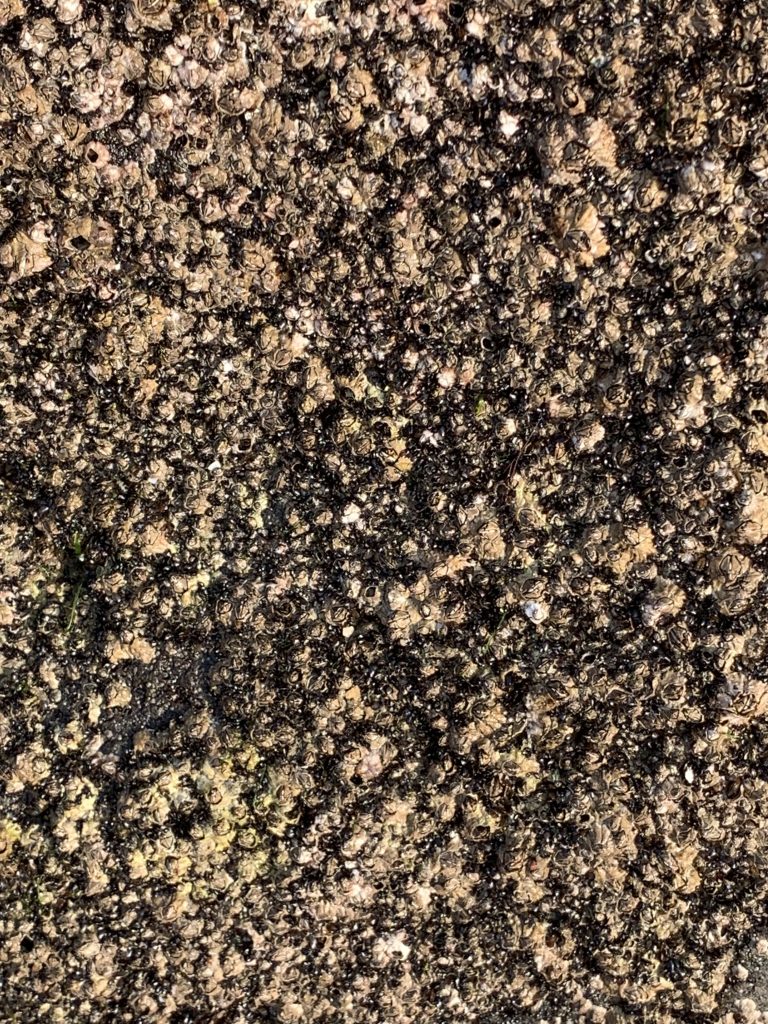
Many of you are finding different ages including very tiny spat at some sites which is really encouraging. Spat so small can be found on barnacles and limpet covered rocks and may even require you to take a hand lens to find.
Survival Trial Visits
Your first visit to your square will have identified where blue mussels are present and their density (for example, whether they occur as individual mussels, clusters, or beds).
For the survival trials, we are interested in how these populations change over the seasons. Please select one accessible mussel bed or cluster within your square and revisit it each month. During each visit, record any noticeable changes, particularly following storms or other significant events.
If your square only contains individual mussels rather than clusters or beds, please continue to visit the same location each month. Record whether the mussels are still present and measure the length (in cm) of the largest and smallest mussel you can find. We appreciate that identifying the exact same mussels each month may not be possible, but tracking the range of sizes present will help us monitor population trends over time.
Track Project Progress by exploring our online map
Click the image below to go to our online map. There you’ll see the we have highlighted our survival sites (yellow markers) and linked in previous sightings of blue mussels from the nature tracking apps, iNaturalist and iRecord. You can tick to toggle them on and off. There is also a toggle for findings from this project – we’ll keep this updated as your records come in and you can see how the overall picture is building up. Good luck exploring, and a BIG THANK YOU for your help!

Please note that while we ask for name and email address, as with other projects, your email will not be publicly shared, or used for any other purpose.
If you’d like to keep in touch about all of our activities, then please subscribe.
For any questions about this project, contact: charlotte@edinburghshoreline.org.uk